


Pawlity® Cruciate Support Collagen Drops: For The Other Knee
Pawlity® Cruciate Support Collagen Drops: For The Other Knee
The daily collagen drops for the knee nobody operated on. Same slope, same rope, no plate. Dosed for his weight, on the food he already eats.
2 fl oz / 60 mL
Feeds The Knee That Wasn't Operated On
Dosed By Weight, Zero Calories
Built For The Ligament, Not The Cartilage
One Dropper A Day, On His Food
Less than 1% of customers claim our Money-Back Guarantee
Couldn't load pickup availability


Dosage & How To Use
Dosage & How To Use
Mix into food once a day. Natural bacon flavor, most dogs lick the bowl clean.
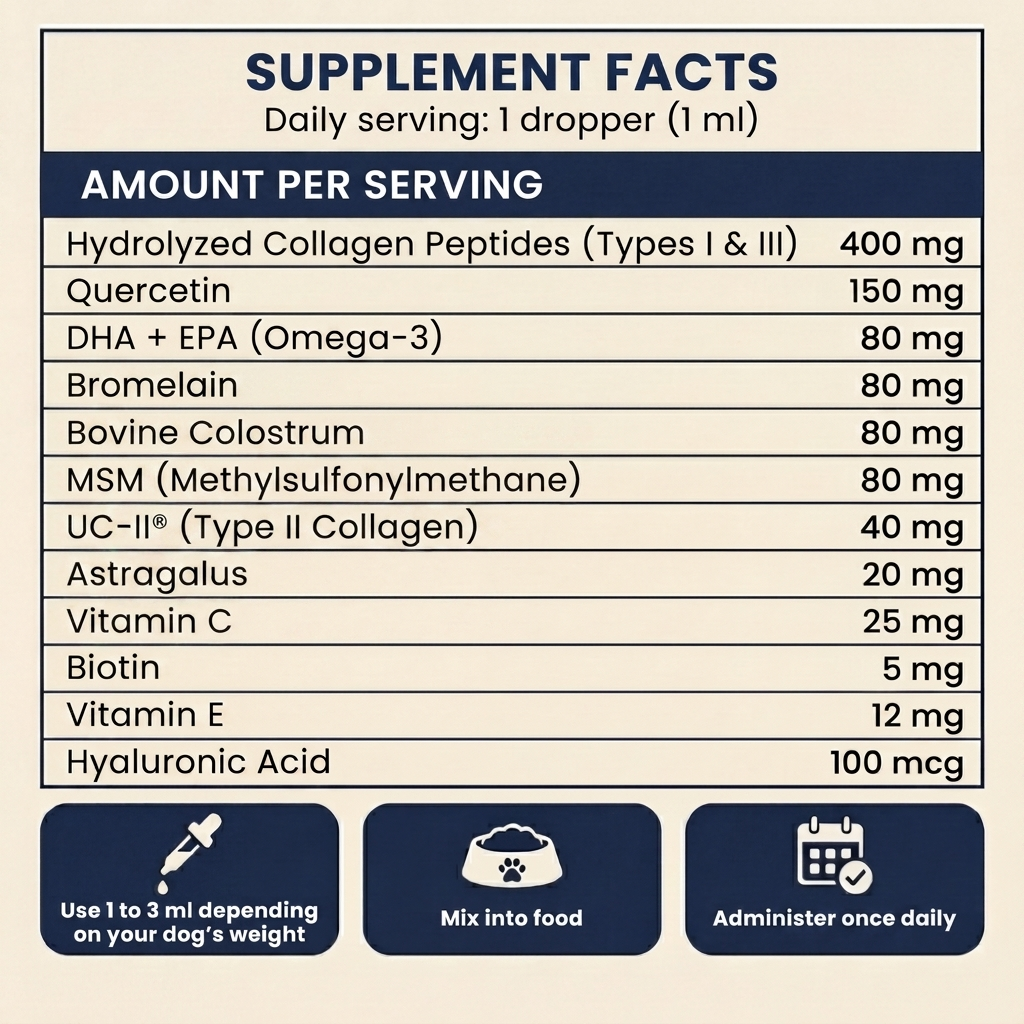
Dosage by weight (one dropper = 1 mL):
→ Under 25 lbs: 1 mL per day, one bottle lasts about 2 months
→ 25 to 75 lbs: 2 mL per day, one bottle lasts about 1 month
→ Over 75 lbs: 3 mL per day, one bottle lasts about 3 weeks
A 2 mL dose delivers 800 mg of hydrolyzed collagen peptides and 80 mg of UC-II. A 3 mL dose delivers 1,200 mg and 120 mg.
One knee already repaired? Same dose. You're feeding the other one. The plate does the work on the operated side. The knee nobody touched still holds him with its own ligament, every second he's standing.
A ligament with almost no blood supply of its own only gets what arrives every day. Skip days, and the rope goes unfed.
Start the day you read this. 90-day money-back guarantee.
Why the second knee goes, and why nothing you were given protects it
Why the second knee goes, and why nothing you were given protects it
After a cruciate surgery, owners are sent home with a recovery plan for the leg that was operated on. Crate rest, short leads, a recheck at twelve weeks. Nobody is given anything for the other knee, because repairing a knee and protecting a knee are two different jobs, and only one of them has a surgeon.
Why a dog's cruciate never rests
A dog's shin bone slopes, about 24 degrees on average. Every time he puts weight on the leg, the shin tries to slide forward and the cruciate ligament holds it back. Standing, walking, waiting for dinner: the rope is loaded every second he's on his feet. Yours rests when you stand. His never does.
What the surgery actually changed
A TPLO cuts the shin bone, rotates it and screws a plate on, so the slope drops to five or six degrees. That knee no longer depends on its ligament. The other one still does. Same slope, same rope, same blood supply, and for twelve weeks it carried him almost alone while the repaired leg healed.
Why it frays instead of snapping
The core of that ligament has almost no blood supply of its own. It's fed by diffusion, by whatever is in the blood that day. A rope under constant load that isn't fed loses the cells that repair it, and its fibers come apart over years. About 80% of cruciate tears are degenerative, not accidents. The pop in the yard is the last fiber going. In a study of 511 dogs who tore one cruciate, 38.7% tore the other one too, on average 57.9 weeks later.
How Pawlity® is different
We feed the rope. Hydrolyzed collagen peptides, types I and III, already broken down so they're in the blood the same day, with the vitamin C his cells can't build collagen without, and UC-II for the cartilage of the same joint. Dosed to the milliliter for his weight, zero calories, every day.
✓ Feeds the ligament itself
✓ Dosed for a 90-pound dog, not a one-size chew
✓ The knee that's still holding, fed every day
Shipping and returns
Shipping and returns
Every Pawlity order ships with full tracking, so you always know where your dog's bottle is. Orders are processed within 24 business hours of purchase. Once dispatched, delivery typically takes 8 to 10 business days depending on your location. You'll receive a tracking link by email as soon as your order ships.
We stand behind every bottle of Pawlity. If you're not satisfied with your order for any reason, simply contact us at info@trypawlity.com within 90 days of delivery and we'll take care of everything. No complicated process, no hassle. We believe in this formula. If your dog doesn't respond the way you hoped, we don't think you should pay for it.
Questions about your order? We're here. Email us at info@trypawlity.com and we'll get back to you within 24 business hours.
Exclusive Formula
Exclusive Formula
PAWLITY® CRUCIATE SUPPORT: WHAT'S INSIDE & WHY IT WORKS
Most joint supplements feed cartilage. Pawlity feeds the ligament, the one tissue nobody addressed after the surgery.
Each dropper delivers hydrolyzed collagen peptides, already broken down, so they're in your dog's blood the same day and reach a ligament that has almost no blood supply of its own.
THE FORMULA (per 1 ml / 1 dropper)
Hydrolyzed Collagen Type I & III, 400mg
The material the cruciate ligament is made of. Type I is the rope itself. Type III is the tissue that repairs. This is the ingredient every hip and joint chew leaves out.
UC-II® Collagen Type II, 40mg
The cartilage of the same knee. 40mg is the dose used in dog studies, including dogs recovering after cruciate surgery.
Vitamin C, 25mg
His cells can't assemble collagen without it. It's the trigger that turns peptides into new fibers.
MSM, 80mg
Organic sulfur, the cofactor his body needs to build its own collagen and connective tissue.
DHA + EPA Omega-3, 80mg
The inflammation inside a loaded knee releases enzymes that digest collagen. Omega-3 calms that from the inside.
Quercetin, 150mg
A natural anti-inflammatory that works upstream, without the side effects of long-term painkillers.
Bromelain, 80mg
An enzyme from pineapple that improves the uptake of quercetin and helps break down inflammatory proteins.
Colostrum, 80mg
Immune support and growth factors that help tissue repair.
Zinc, 8mg
Required for collagen synthesis. Low zinc means slow repair.
Astragalus, 20mg
Supports immune balance during long recoveries.
Vitamin E, 12mg
Protects new collagen from oxidative damage while it's being laid down.
Biotin, 5mg
Supports coat and skin, because a dog in recovery still has to look like himself.
Hyaluronic Acid, 100mcg
A trace of the molecule that keeps joint fluid smooth.
WHY IT'S DIFFERENT
✓ Built for the ligament, not the cartilage
✓ Dosed to the milliliter for his weight: a 90-pound dog gets a 90-pound dose
✓ Zero calories, because every pound he put on in the crate loads the rope harder
✓ Mixes into food in seconds, no pill fights
✓ Safe alongside pain medication and after surgery
✓ One dropper a day, every day, because a tissue without blood only gets what arrives today
90-Day Money-Back Guarantee
90-Day Money-Back Guarantee
Many owners notice a steadier rise after rest within the first month, but we know every dog is different, and a ligament is fed over months, not days.
That's why we offer our guarantee: try it for a full ninety days, and if you're not satisfied, email us at info@trypawlity.com and we'll refund you, no questions asked. The risk is on us, not on you. You've already paid for one knee.
How quickly will I see results?
How quickly will I see results?
Weeks 1 to 2: nothing you can see. The peptides are in his blood, the ligament is being fed, but a rope doesn't change in a week. We'd rather tell you that now.
Weeks 3 to 4: most owners notice the first thing in the morning. He gets up from his bed with less of that stiff pause, and walks it off faster.
Weeks 6 to 8: he loads both back legs evenly again, the crooked sit happens less, the stairs and the car stop being a negotiation.
3 months: that's how long it takes to feed a ligament. Then keep going. The slope in his shin doesn't change, so the rope is loaded every day for the rest of his life, and it has to be fed every day.
What we don't promise: drops don't rebuild the knee that was operated on, and they don't replace the plate. We feed the knee that's still holding, the one nobody else is looking after.


The other knee, still holding
-

"Dutch had his right knee done in February. $4,050 and twelve weeks in a crate. In June I read that 38.7% tear the other one too, and I knew exactly where that could go. Four months on the drops, and last week's recheck: holding."
-

"Nobody gave me anything for the good knee. Just 'keep an eye on it.' Bosco is 96 pounds and that leg carried him alone all spring. Eight weeks in, he sits square and loads both sides again."
-

"Juno's TPLO was eleven months ago. I found out the average second tear is around a year and I stopped sleeping. Started the drops that week. She's still on all four, and I've stopped watching every step."


The plate fixed one knee. Nothing ever touched the other.
A TPLO doesn't repair a ligament. It cuts the shin bone, rotates it and screws a plate on, so that knee stops needing its cruciate at all. It worked. That leg is fine.
The other knee still hangs on its own rope. Same 24-degree slope, same collagen, same blood supply, and for twelve weeks it carried him almost alone while the repaired side healed. The core of that ligament has almost no blood supply of its own: it's fed by diffusion, by whatever is in his blood that day. A rope under constant load that isn't fed frays, fiber by fiber, for years before the pop. In 511 dogs who tore one cruciate, 38.7% tore the other one too, on average 57.9 weeks later.
Glucosamine and chondroitin feed cartilage. The brace holds the knee from the outside. Rest takes the load off for a while and puts it straight back. None of them feed the rope.
Pawlity® feeds the ligament itself: hydrolyzed collagen, the vitamin C it can't be built without, and UC-II for the cartilage of the same joint. Dosed to the milliliter for his weight. Zero calories. Every day, because a tissue without blood only gets what arrives today.
✔️ Feeds the knee nobody operated on ✔️ Dosed for his weight, zero calories ✔️ Every day, for the rest of his life
Here's what actually happens, week by week
A ligament doesn't get fed overnight. But when it does, the knee that's still holding keeps holding, not because we numbed anything, but because the rope is finally being fed.

The knee nobody is watching
One knee is repaired and fine. The other one has carried him since the day of the surgery. You've added a joint chew, a ramp, a lot of watching. None of it feeds a ligament. You hold your breath every time he jumps off the couch.
"The surgeon said there's a good chance the other one goes too. Then he handed me the discharge papers."
- One knee repaired, the other one never looked at
- He still favors the repaired leg, so the other takes it all
- Same slope, same rope, no plate on that side
- 3 to 12 months post-op: the average second tear comes at 57.9 weeks

The first easy rise after a nap
Hydrolyzed collagen peptides are in his blood within the hour and reach the ligament by diffusion, a little more each day. Vitamin C and MSM give his cells what they need to lay down new fibers. You notice it first in the morning.
"He got up from his bed this morning like it was nothing. I actually stopped and watched."
- Less stiff after rest, most mornings
- Fewer skipped steps on the stairs
- The crooked sit happens less often
- He's keen for the walk again

He plants all four again
Weeks of daily peptides have reached the core of the ligament, the part that has almost no blood supply of its own. Now it gets fed while it works. This isn't bracing. This isn't masking. It's feeding.
"He climbed into the truck on his own yesterday. He hasn't loaded both back legs like that since the crate came down."
- Sits square, both legs tucked
- Plants all four paws after fetch
- Stairs and the car without a pause
- The other knee, still holding
The knee nobody is watching
One knee is repaired and fine. The other one has carried him since the day of the surgery. You've added a joint chew, a ramp, a lot of watching. None of it feeds a ligament. You hold your breath every time he jumps off the couch.
"The surgeon said there's a good chance the other one goes too. Then he handed me the discharge papers."
- One knee repaired, the other one never looked at
- He still favors the repaired leg, so the other takes it all
- Same slope, same rope, no plate on that side
- 3 to 12 months post-op: the average second tear comes at 57.9 weeks
The first easy rise after a nap
Hydrolyzed collagen peptides are in his blood within the hour and reach the ligament by diffusion, a little more each day. Vitamin C and MSM give his cells what they need to lay down new fibers. You notice it first in the morning.
"He got up from his bed this morning like it was nothing. I actually stopped and watched."
- Less stiff after rest, most mornings
- Fewer skipped steps on the stairs
- The crooked sit happens less often
- He's keen for the walk again
He plants all four again
Weeks of daily peptides have reached the core of the ligament, the part that has almost no blood supply of its own. Now it gets fed while it works. This isn't bracing. This isn't masking. It's feeding.
"He climbed into the truck on his own yesterday. He hasn't loaded both back legs like that since the crate came down."
- Sits square, both legs tucked
- Plants all four paws after fetch
- Stairs and the car without a pause
- The other knee, still holding
Three things a ligament is made of. Fed every day.

Collagen Type I & III (400mg)

UC-II® Type II Collagen (40mg)

Quercetin (150mg)

Bromelain (80mg)

DHA + EPA Omega-3 (80mg)

Colostrum (80mg)

MSM (80mg)

Astragalus (20mg)

Vitamin C (25mg)

Zinc (8mg)

Biotin (5mg)

Vitamin E (12mg)

Hyaluronic Acid (100mcg)

Why drops, dosed by weight
A ligament is fed by what's in the blood every day, in proportion to the dog. A 90-pound Rottweiler needs more collagen than a 20-pound terrier, and a fixed chew can't do that. One dropper is one milliliter: 1 mL under 25 lbs, 2 mL from 25 to 75 lbs, 3 mL over 75 lbs. A 90-pound dog gets a 90-pound dose.
Zero calories, and that matters more after a surgery than before it. Twelve weeks in a crate puts weight on a dog, and every extra pound loads the remaining rope harder with every step. Overweight dogs tear their cruciate at close to four times the rate.
And no pill fights. Natural bacon flavor, mixed into the food he already eats, gone in five seconds.

Vet Approved
"I rehab dogs after cruciate surgery every week. The repaired knee is the one everybody watches, and it's the one that's fine: it has a plate. The knee I worry about is the other one, because it has no plate, the same slope, and it has been carrying the whole dog since the day of the operation. Glucosamine is for cartilage. A ligament is collagen. I'd rather owners feed that rope every day than wait and see if it holds."
Dr. Nora Castellano, DVM, CCRP, Certified Canine Rehabilitation Practitioner
FREQUENTLY ASKED QUESTIONS

My dog already had TPLO surgery. Is it too late?
My dog already had TPLO surgery. Is it too late?
It's exactly the time. The surgery leveled one shin and screwed a plate on, so that knee no longer depends on its ligament. The other knee still does. It has the same slope, the same rope, the same blood supply, and it carried him almost alone through twelve weeks of recovery. In a study of 511 dogs who tore one cruciate, 38.7% tore the other one too, on average 57.9 weeks later, which is a little over a year after the first. That's the knee we feed. Same dose as any dog his weight, on his food, every day, starting now. Pawlity doesn't replace your surgeon's recovery plan. It runs alongside it.
We never did the surgery. He got better on his own. Is this still for us?
We never did the surgery. He got better on his own. Is this still for us?
Yes, and there is a case for saying it matters more. A torn cruciate does not knit back together. What settles a knee down without surgery is scar tissue thickening around the joint until it stops sliding, so he walks and runs on a knee that was never repaired.
You also do not have the one thing surgery leaves behind. A levelled shin bone takes that knee off the table for good. Your dog never got that, so both of his knees are still held by their own collagen, on the same two slopes, fed by the same blood. Every reason to feed the rope applies to him twice.
Same dose as any dog his weight, on his food, every day. Dogs who do well on the conservative route are mostly the smaller ones, so check the weight chart: most of them are on 1 or 2 mL, not 3.
How does it work exactly?
How does it work exactly?
Your dog's cruciate ligament is a rope of collagen that never rests: his shin bone slopes, so the ligament holds his weight every second he's standing. The core of that rope has almost no blood supply of its own. It's fed by diffusion, by whatever is in the blood that day. A rope that's loaded all day and not fed frays over years, which is why most cruciate tears aren't accidents. Pawlity puts hydrolyzed collagen peptides, vitamin C and UC-II into his blood every day, dosed for his weight, so the ligament gets what it's made of while it works.
How is it different from glucosamine or Dasuquin?
How is it different from glucosamine or Dasuquin?
Glucosamine and chondroitin are the building blocks of cartilage. Good ingredients, wrong tissue. The cruciate ligament isn't cartilage: it's collagen, type I mostly, and nothing in a hip and joint chew feeds it. That's why the joint chew you started after the surgery doesn't protect the other knee. Pawlity is built around the collagen the ligament is made of, with the vitamin C his cells need to assemble it. Many owners keep their joint chew for the cartilage and add Pawlity for the rope. They do different jobs.
The surgeon said to just keep an eye on it. Isn't that enough?
The surgeon said to just keep an eye on it. Isn't that enough?
Watching a ligament doesn't feed it. Your surgeon repaired the knee he was asked to repair, and he did it well. Monitoring the other one isn't anybody's job, which is why you were sent home with a recovery plan for one leg and nothing for the other. The fraying happens quietly, over months, in a tissue with almost no blood supply. By the time you can see it, you're looking at a second estimate. Feeding the rope is the one thing you can do every day between rechecks.
How long before I see anything?
How long before I see anything?
Weeks 1 to 2, nothing visible. Weeks 3 to 4, most owners notice a steadier rise after rest. Weeks 6 to 8, he loads both back legs evenly again and the crooked sit happens less. Three months is how long it takes to feed a ligament, which is why most owners take the three-bottle pack, and the five-bottle pack if their dog is over 75 lbs. After that it's for life: the slope in his shin doesn't change, so the rope is loaded every day he's on his feet.
Is it safe with his medication, or after surgery?
Is it safe with his medication, or after surgery?
Yes. These are nutrients his body already uses to build connective tissue. Pawlity doesn't suppress anything and doesn't interfere with anti-inflammatories, pain medication or a post-surgery recovery plan. Many owners start it during the twelve weeks of crate rest, exactly when the other knee is taking the most load. Produced in a cGMP-certified facility, safe for daily long-term use. It contains bovine colostrum, so if your dog is dairy-sensitive, ask your vet first.
My dog weighs 90 pounds. How much should I give?
My dog weighs 90 pounds. How much should I give?
3 mL a day, three droppers on his food. Under 25 lbs is 1 mL, 25 to 75 lbs is 2 mL, over 75 lbs is 3 mL. That's the point of drops: a big dog's ligament gets a big dog's dose. At 3 mL a bottle lasts about three weeks, which is why large-breed owners usually take the three or five-bottle pack.
Why drops instead of chews?
Why drops instead of chews?
Two reasons. Dose: a ligament is fed in proportion to the dog, and one dropper per 25 pounds does what a fixed chew count can't. Weight: drops carry zero calories, and a dog who spent twelve weeks in a crate usually comes out heavier, which loads the remaining rope harder with every step. Overweight dogs tear their cruciate at close to four times the rate. Bacon flavor, on his food, no pill fights.
What if it doesn't work for my dog?
What if it doesn't work for my dog?
We offer a 90-day money-back guarantee. Give it a full ninety days, and if you don't see the difference, contact us for a full refund. No questions asked. The risk is on us. You've already paid for one knee.
Rated 4.7 / 5 based on 512 reviews. Showing our 5-star reviews.