


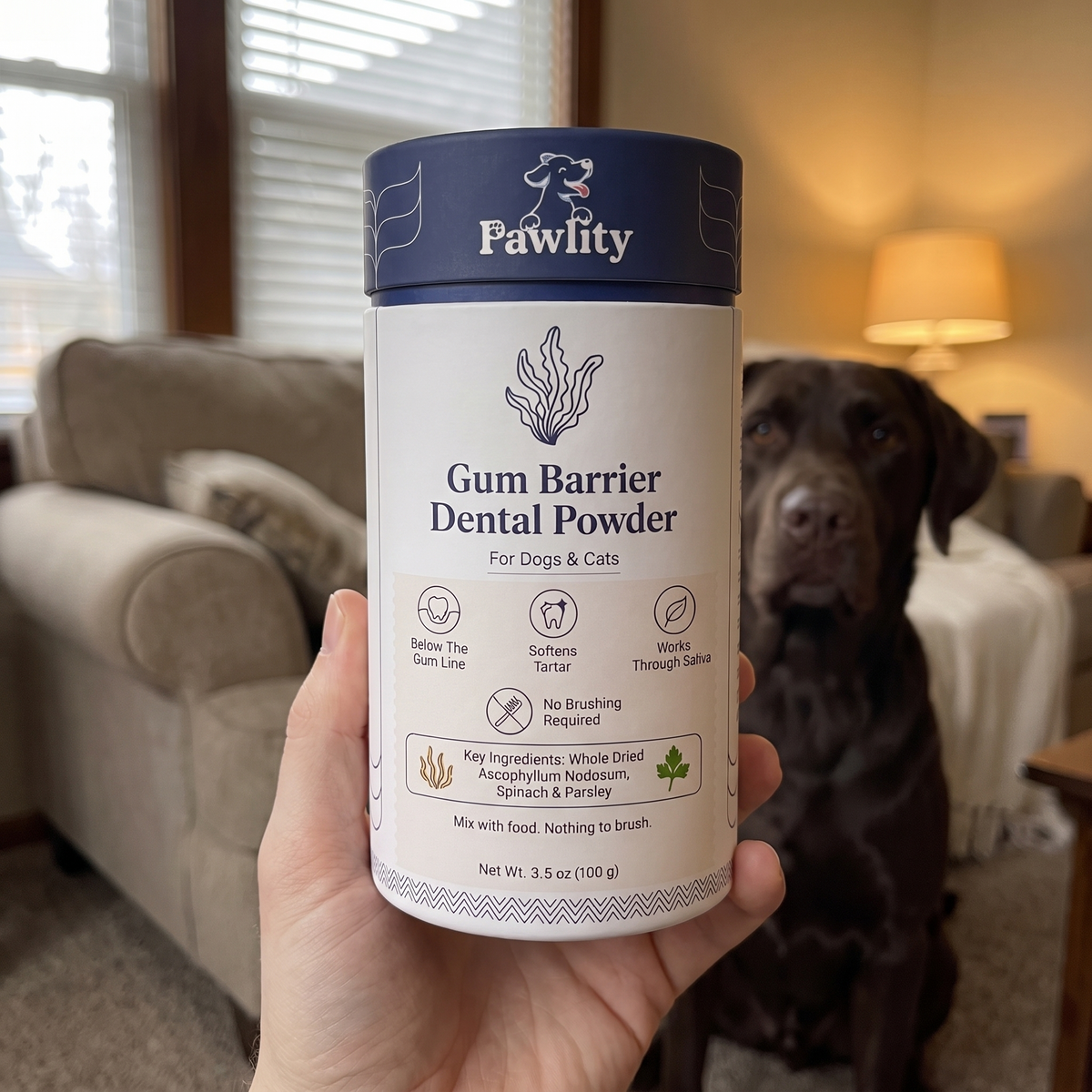
Pawlity® Gum Barrier Dental Powder
Pawlity® Gum Barrier Dental Powder
Lift his lip tonight. A red line where the gum meets the tooth means the pocket is already open, and what is in it does not stay in his mouth.
100 g · 50 scoops · 25 days at two scoops · scoop included
Reaches under the gum. Nothing to brush.
$1 a day against $1,247 and an anaesthetic.
1 sick dog in 73 never wakes up
No mint. If the smell goes, you know why.
Couldn't load pickup availability


Dosage & How To Use
Dosage & How To Use
One scoop is 2 g and the scoop is in the tub. Sprinkle it on his food once a day, dry or wet. There is nothing to brush, nothing to hold his mouth open for, nothing he has to chew for thirty seconds.
Dosage by weight:
→ Under 22 lbs: 1 scoop per day, one tub lasts about 50 days
→ 22–44 lbs: 2 scoops per day, one tub lasts about 25 days
→ 44–77 lbs: 2 scoops per day, one tub lasts about 25 days
→ Over 77 lbs: 3 scoops per day, one tub lasts about 16 days
It works through his saliva, and saliva turns over constantly. What is not in his blood today is not in his saliva tonight, so a day skipped is a day the pocket gets back.
Not sure yet? Start with one tub. 90-day money-back guarantee.
The real reason nothing you have bought for his mouth has worked
The real reason nothing you have bought for his mouth has worked
Everything sold for a dog's mouth works in the same place: on the surface of the tooth, above the gum line. The brush, the dental stick, the rope toy, the bone, the water additive, the forty-dollar enzyme spray with a vet's face on the box. All of them, above the line.
The problem is below it.
Under the edge of his gum there is a pocket, three to ten millimetres deep, that should not exist. It is not a surface any more. It is an open wound, millimetres from his bloodstream. Nothing you put in his mouth goes down there. To reach it through his mouth you need general anaesthesia and a curette, and that is exactly why a cleaning costs $1,247.
But it works fine in the other direction.
Every time he chews, bacteria leave that pocket and go into his blood. That is not a theory. Researchers drew blood from dogs classified by the severity of their gum disease, right after chewing and brushing, and cultured it: positive in one out of four.
They do not stay in his mouth. Across 164,706 dogs, for every square centimetre of gum disease there was 1.4 times more damage on the valves of the left side of the heart, and kidney risk climbed with every stage.
How Pawlity® is different
There is exactly one thing that sits in that pocket twenty-four hours a day, and it is his saliva. Saliva comes from his blood. So we do not put anything on his teeth. He swallows it, it goes into his blood, and it comes back out in his saliva.
✓ Reaches below the gum line
✓ Nothing to brush, nothing to hold him still for
✓ No mint, so the smell stays honest
Shipping and returns
Shipping and returns
Every Pawlity order ships with full tracking, so you always know where your dog's tub is. Orders are processed within 24 business hours of purchase. Once dispatched, delivery typically takes 8 to 10 business days depending on your location. You'll receive a tracking link by email as soon as your order ships.
We stand behind every tub of Pawlity. If you're not satisfied with your order for any reason, simply contact us at info@trypawlity.com within 90 days of delivery and we'll take care of everything, no complicated process, no hassle.
Questions about your order? Email us at info@trypawlity.com and we'll get back to you within 24 business hours.
Exclusive Formula
Exclusive Formula
PAWLITY® — WHAT'S INSIDE & WHY IT WORKS
Everything else works on the tooth. This works in the liquid that is already inside the pocket.
He swallows it with his food. It enters his bloodstream, and it comes back into his mouth through his saliva, which is the only thing on earth that sits in that pocket every hour of every day, whether you are watching or not.
THE FORMULA (per 2 g scoop; two scoops a day for most dogs)
Ascophyllum nodosum, whole dried — 300 mg
A cold-water brown seaweed, dried whole and ground, the same form the trial used. Swallowed, not scrubbed. It comes back into the mouth through his saliva, down into the pocket, and strips the sticky film the bacteria build to hold onto the tooth. Without that film they lose their grip, and the tartar that was cemented to it starts letting go. Randomised, double blind, against placebo, ninety days, in dogs: plaque 38% lower than placebo, tartar 35% lower by day 30, gum bleeding 67% lower, and the sulphur compounds behind the smell 24%, 35% and 46% lower at days 30, 60 and 90.
Spinach powder — 400 mg
One of the densest natural sources of chlorophyll, which binds sulphur-based odour molecules instead of covering them with a scent. It works on what you smell while the seaweed works on what makes it.
Parsley powder — 400 mg
Chlorophyll again, plus the flavonoids that made parsley the original breath herb. Most dental products use it at a token dose. 400 mg a scoop is not a token.
Brewer's yeast powder — 400 mg
B vitamins, and the savoury note that makes two scoops disappear off the bowl in four seconds, without a treat shape, a coating or a mint. The trial only worked in dogs that got the dose every day: this is what makes every day happen.
Green tea extract, caffeine-free — 20 mg
Catechins with documented antibacterial activity in the oral environment. A small supporting dose, and caffeine-free because caffeine has no place in a dog.
Base: chicken liver powder, silicon dioxide.
The flavour he goes for, and the anti-caking agent that keeps a powder pourable. Nothing else.
WHAT IS NOT IN IT, AND WHY THAT MATTERS
✗ No bicarbonate, no calcium carbonate, no abrasive. We are not scrubbing anything.
✗ No surfactant, no foaming agent. This is swallowed, not a toothpaste.
✗ No mint, no peppermint. The smell is the only reading you get on that pocket. We are not covering it up, we are taking away what makes it. Which means if the smell goes, you know why.
WHY IT'S DIFFERENT
✓ The only dental product that does not go in through his mouth
✓ Four seconds a day, and he does not have to cooperate
✓ A 2 g scoop in the tub, so the dose is a dose and not a pinch
✓ Safe for daily long-term use, dogs and cats
✓ Not for dogs with a thyroid condition: brown seaweed is naturally high in iodine. Ask your vet first.
90-Day Money-Back Guarantee
90-Day Money-Back Guarantee
The smell usually moves first, because the sulphur compounds are the fastest thing to change. The gum line takes longer. Tartar that has already hardened does not come off, it stops spreading.
So we give you ninety days: try it, and if his breath has not changed, email us at info@trypawlity.com and we refund you, no questions asked. The risk is ours. It has been his for years.
How quickly will I see results?
How quickly will I see results?
Weeks 1 and 2, nothing. We would rather tell you than sell you.
Weeks 2 to 4, the smell changes. You notice it the way you noticed the problem in the first place: when he yawns at you, or puts his head on your lap.
Weeks 4 to 8, lift his lip again. The red line along the tooth is the thing to watch, not the teeth themselves.
Tartar that is already mineralised will not dissolve. What changes is that it stops growing, and that the pocket feeding it gets less to work with.
More than 80% of dogs already have signs of oral disease by their third birthday. It does not start in old age. It ends there. Which is why this is a daily thing, not a course.


What changed in their mouths
-

"I lifted Ranger's lip in the kitchen because of this and there was a red line on every back tooth. He is six. Nobody had ever told me to look."
-

"The quote was $1,247 and a general anaesthetic. Bodie is twelve. I said no, and then I panicked for a year about saying no. This is the first thing I have found that does anything while he is not on that table."
-

"Four seconds on his food. That is the whole thing. I had been buying dental sticks for six years."


Brushes work above the line. The problem is below it.
Under the edge of his gum there is a pocket, three to ten millimetres deep. It is not a surface any more, it is an open wound, millimetres from his bloodstream.
Nothing you have ever put in his mouth goes down there. Not the brush, not the stick, not the bone, not the spray. To reach it through his mouth takes general anaesthesia and a curette. That is why the cleaning costs $1,247.
But it works fine in the other direction. Every time he chews, his own bacteria leave that pocket and enter his blood. They drew blood from dogs right after eating and grew it: positive in one out of four.
And blood does not stop in his mouth. Across 164,706 dogs, the further the gum disease had gone, the more damage turned up on the valves of the heart. Nobody is going to tell you one causes the other. They are going to tell you the two turn up together, in that many dogs.
So there is exactly one way in, and it is not through his mouth. He swallows it. It goes into his blood. It comes back out in his saliva, and his saliva is the only thing that sits in that pocket twenty-four hours a day.
✔️ Reaches below the gum line
✔️ Nothing to brush, no anaesthesia, no $1,247
✔️ No mint, so the smell stays honest
Here's what actually happens, week by week
The pocket does not close overnight. But the smell moves first, and the smell is the only reading you get. Not because we suppressed it, but because you will know exactly why it went.

The smell is a wound talking
You smell it when he yawns at you, and the gum line is red. You've tried sticks, sprays, water additives, and every one of them works above the gum line. The pocket is below it.
"$1,247 and a general anaesthetic. He's twelve. I said no."
- A red line where the gum meets the tooth
- Breath you can smell across the room
- Tartar building at the back teeth
- His own bacteria into his blood at every meal

The first yawn you don't turn away from
Two scoops on his food every morning. Four seconds. He never noticed. No missed days. Now Ascophyllum comes back through his own saliva , the only thing already inside the pocket, and strips the film the bacteria hold onto right under the gum line. They lose their grip, and the sulphur gas starts dropping. You notice it when he puts his head on your lap.
"I realised I had stopped turning my head away. That was the moment."
- Breath noticeably changed
- Less film on the back teeth
- The gum line looks less angry
- No mint in the tub, so it is real

The line goes from red to pink
Eight weeks of daily scoops, 600mg of whole dried seaweed a day, carried in by his own saliva , into the pocket itself. The bacteria lose the film they hold onto, and the tartar cemented to it starts letting go. Nothing was masked. Lift his lip and look.
"The line was red in March. In June it was pink. Same dog, same mouth."
- Gum line pink along the tooth
- Tartar stopped spreading
- Breath stays changed, not covered
- No anaesthesia on the calendar
One ingredient with a trial, four helpers, and nothing to perfume the smell.

Ascophyllum

Spinach

Parsley

Green Tea

Brewer's Yeast

Why swallowed beats scrubbed
The best product in the world is useless if it cannot physically reach the problem.
A dental stick asks him to chew for thirty seconds, on the right side, every day. A brush asks him to hold his mouth open. A spray asks you to aim at a gum line he does not want you near. And all three of them work on the part of the tooth you can see.
A powder asks nothing of him. Two scoops on his food, four seconds, and he does not even know it happened. It goes into his blood and comes back into his mouth in his saliva, which is already in the pocket and has been all along.
In the literature on this seaweed, powder is the form with the strongest preventive effect, ahead of dental bites and ahead of dry food. Perfect compliance is the compliance that asks him for nothing.

Vet Approved
"I spend my week cleaning pockets under general anaesthetic on dogs who are old enough that the anaesthetic itself is the thing keeping their owners awake. In the largest study we have, one in seventy-three sick dogs does not wake up, against one in one thousand one hundred and thirty-six for a healthy one, and chronic infection in the mouth is what moves a dog from the first number to the second. Anything a dog can swallow that reaches below the gum line buys us years before that decision has to be made."
— Dr. Marcus Yardley, DVM, DAVDC — Veterinary Dentistry & Oral Surgery
WHAT OWNERS ASK BEFORE THEY LIFT THE LIP
How does it work exactly?
How does it work exactly?
Under the edge of his gum there is a pocket, three to ten millimetres deep, and nothing you put in his mouth reaches it. The only thing that touches that pocket every hour of every day is his saliva, and his saliva comes from his blood. So he swallows the powder, it enters his blood, and it comes back into his mouth in his saliva. Once it is there, it strips the film the bacteria build to hold onto the tooth. They lose their grip, and the tartar cemented to that film starts letting go.
How is it different from a $1,247 cleaning?
How is it different from a $1,247 cleaning?
A cleaning scrapes the pocket out once, under general anaesthesia. Then it fills back in. That is a subscription, not a cure, and every year you repeat it your dog is a year older on the table. In the largest study on canine anaesthesia, 1 in 1,136 healthy dogs does not wake up. In sick dogs it is 1 in 73. Chronic infection in the mouth is what moves a dog from the first number to the second. This does not replace a cleaning your vet says is urgent. It is what you do the other 364 days.
Why a powder instead of a chew, a spray or a brush?
Why a powder instead of a chew, a spray or a brush?
Because of where the problem is. A chew, a spray and a brush all work above the gum line, on the part of the tooth you can see. The pocket is below it. In the literature on this seaweed, powder is the form with the strongest preventive effect, ahead of dental bites and ahead of dry food, and it is the only form your dog does not have to cooperate with. Two scoops on his food, four seconds, done.
How long does it take to see results?
How long does it take to see results?
Weeks 1 and 2, nothing. The smell usually moves between weeks 2 and 4, because the sulphur compounds are the fastest thing to change. The gum line takes longer, and that is the thing to watch: lift his lip at week 6 and follow the line where the gum meets the tooth. Tartar that has already hardened does not dissolve, it stops spreading.
Is it safe, and who should not take it?
Is it safe, and who should not take it?
It is whole dried seaweed with spinach, parsley, brewer's yeast and a little green tea, on a chicken liver base, swallowed with food. No abrasive, no surfactant, no foaming agent, no mint, no fragrance oil.
One warning, and we print it on the tub: brown seaweed is naturally very high in iodine. This is not for a dog with a thyroid condition or on thyroid medication. If you are not sure, ask your vet before the first scoop. One question, one answer.
How much should I give?
How much should I give?
One scoop is 2 g and the scoop is in the tub. Under 22 lbs, one scoop a day. 22 to 77 lbs, two. Over 77 lbs, three. Sprinkle it on his food, dry or wet. There is no ramp-up and nothing to measure by eye.
What if it doesn't work for my dog?
What if it doesn't work for my dog?
We offer a 90-day money-back guarantee. If his breath has not changed, keep the tub and email us for a full refund. No questions asked. The risk is ours, it has been his for years.
Why has nobody told me about the pocket?
Why has nobody told me about the pocket?
Because nobody writes "teeth" on the certificate. They write heart. They write kidney. They write cardiac arrest under anaesthesia. The cause and the outcome never carry the same name, so the link never gets made in front of you.
And because the fix your vet is trained to offer needs an operating table. Telling you to brush is what is left when the real answer costs $1,247.
Rated 4.8 / 5 based on 3,300+ reviews. Showing our 5-star reviews.